
Saturday, May 1, 2010

Sunday, April 18, 2010

Thursday, April 15, 2010
Collected Quotes from Albert Einstein
- "Any intelligent fool can make things bigger, more complex, and more violent. It takes a touch of genius -- and a lot of courage -- to move in the opposite direction."
- "Imagination is more important than knowledge."
- "Gravitation is not responsible for people falling in love."
- "I want to know God's thoughts; the rest are details."
- "The hardest thing in the world to understand is the income tax."
- "Reality is merely an illusion, albeit a very persistent one."
- "The only real valuable thing is intuition."
- "A person starts to live when he can live outside himself."
- "I am convinced that He (God) does not play dice."
- "God is subtle but he is not malicious."
- "Weakness of attitude becomes weakness of character."
- "I never think of the future. It comes soon enough."
- "The eternal mystery of the world is its comprehensibility."
- "Sometimes one pays most for the things one gets for nothing."
- "Science without religion is lame. Religion without science is blind."
- "Anyone who has never made a mistake has never tried anything new."
- "Great spirits have often encountered violent opposition from weak minds."
- "Everything should be made as simple as possible, but not simpler."
- "Common sense is the collection of prejudices acquired by age eighteen."
- "Science is a wonderful thing if one does not have to earn one's living at it."
- "The secret to creativity is knowing how to hide your sources."
- "The only thing that interferes with my learning is my education."
- "God does not care about our mathematical difficulties. He integrates empirically."
- "The whole of science is nothing more than a refinement of everyday thinking."
- "Technological progress is like an axe in the hands of a pathological criminal."
- "Peace cannot be kept by force. It can only be achieved by understanding."
- "The most incomprehensible thing about the world is that it is comprehensible."
- "We can't solve problems by using the same kind of thinking we used when we created them."
- "Education is what remains after one has forgotten everything he learned in school."
- "The important thing is not to stop questioning. Curiosity has its own reason for existing."
- "Do not worry about your difficulties in Mathematics. I can assure you mine are still greater."
- "Equations are more important to me, because politics is for the present, but an equation is something for eternity."
- "If A is a success in life, then A equals x plus y plus z. Work is x; y is play; and z is keeping your mouth shut."
- "Two things are infinite: the universe and human stupidity; and I'm not sure about the the universe."
- "As far as the laws of mathematics refer to reality, they are not certain, as far as they are certain, they do not refer to reality."
- "Whoever undertakes to set himself up as a judge of Truth and Knowledge is shipwrecked by the laughter of the gods."
- "I know not with what weapons World War III will be fought, but World War IV will be fought with sticks and stones."
- "In order to form an immaculate member of a flock of sheep one must, above all, be a sheep."
- "The fear of death is the most unjustified of all fears, for there's no risk of accident for someone who's dead."
- "Too many of us look upon Americans as dollar chasers. This is a cruel libel, even if it is reiterated thoughtlessly by the Americans themselves."
- "Heroism on command, senseless violence, and all the loathsome nonsense that goes by the name of patriotism -- how passionately I hate them!"
- "No, this trick won't work...How on earth are you ever going to explain in terms of chemistry and physics so important a biological phenomenon as first love?"
- "My religion consists of a humble admiration of the illimitable superior spirit who reveals himself in the slight details we are able to perceive with our frail and feeble mind."
- "Yes, we have to divide up our time like that, between our politics and our equations. But to me our equations are far more important, for politics are only a matter of present concern. A mathematical equation stands forever."
- "The release of atom power has changed everything except our way of thinking...the solution to this problem lies in the heart of mankind. If only I had known, I should have become a watchmaker."
- "Great spirits have always found violent opposition from mediocrities. The latter cannot understand it when a man does not thoughtlessly submit to hereditary prejudices but honestly and courageously uses his intelligence."
- "The most beautiful thing we can experience is the mysterious. It is the source of all true art and all science. He to whom this emotion is a stranger, who can no longer pause to wonder and stand rapt in awe, is as good as dead: his eyes are closed."
- "A man's ethical behavior should be based effectually on sympathy, education, and social ties; no religious basis is necessary. Man would indeeded be in a poor way if he had to be restrained by fear of punishment and hope of reward after death."
- "The further the spiritual evolution of mankind advances, the more certain it seems to me that the path to genuine religiosity does not lie through the fear of life, and the fear of death, and blind faith, but through striving after rational knowledge."
- "Now he has departed from this strange world a little ahead of me. That means nothing. People like us, who believe in physics, know that the distinction between past, present, and future is only a stubbornly persistent illusion."
- "You see, wire telegraph is a kind of a very, very long cat. You pull his tail in New York and his head is meowing in Los Angeles. Do you understand this? And radio operates exactly the same way: you send signals here, they receive them there. The only difference is that there is no cat."
- "One had to cram all this stuff into one's mind for the examinations, whether one liked it or not. This coercion had such a deterring effect on me that, after I had passed the final examination, I found the consideration of any scientific problems distasteful to me for an entire year."
- "...one of the strongest motives that lead men to art and science is escape from everyday life with its painful crudity and hopeless dreariness, from the fetters of one's own ever-shifting desires. A finely tempered nature longs to escape from the personal life into the world of objective perception and thought."
- "He who joyfully marches to music rank and file, has already earned my contempt. He has been given a large brain by mistake, since for him the spinal cord would surely suffice. This disgrace to civilization should be done away with at once. Heroism at command, how violently I hate all this, how despicable and ignoble war is; I would rather be torn to shreds than be a part of so base an action. It is my conviction that killing under the cloak of war is nothing but an act of murder."
- "A human being is a part of a whole, called by us _universe_, a part limited in time and space. He experiences himself, his thoughts and feelings as something separated from the rest... a kind of optical delusion of his consciousness. This delusion is a kind of prison for us, restricting us to our personal desires and to affection for a few persons nearest to us. Our task must be to free ourselves from this prison by widening our circle of compassion to embrace all living creatures and the whole of nature in its beauty."
- "Not everything that counts can be counted, and not everything that can be counted counts." (Sign hanging in Einstein's office at Princeton)
Copyright: Kevin Harris 1995 (may be freely distributed with this acknowledgement)
Saturday, April 10, 2010

Friday, March 26, 2010
Sunday, March 14, 2010
Saturday, March 13, 2010
Thursday, March 11, 2010
Saturday, March 6, 2010
Wednesday, February 17, 2010
Tuesday, February 16, 2010
Wednesday, February 10, 2010
Sunday, February 7, 2010
Saturday, January 30, 2010
Tuesday, January 26, 2010
Monday, January 25, 2010

Sunday, January 24, 2010
Tuesday, January 19, 2010
Monday, January 18, 2010
Tuesday, January 12, 2010
Saturday, January 9, 2010
Thursday, January 7, 2010
Monday, December 21, 2009
Sunday, December 13, 2009
Friday, August 28, 2009
Tuesday, November 11, 2008
Friday, August 15, 2008
Thursday, June 26, 2008
Wednesday, June 25, 2008
Monday, June 23, 2008
Friday, June 20, 2008
Thursday, June 19, 2008
Wednesday, June 18, 2008
Monday, June 9, 2008
Wednesday, June 4, 2008
Wednesday, May 21, 2008
Monday, May 12, 2008
Tuesday, May 6, 2008
Wednesday, April 30, 2008
Wednesday, April 23, 2008
Monday, April 21, 2008
Friday, April 18, 2008
Thursday, April 17, 2008
Tuesday, April 15, 2008
Thursday, April 10, 2008


Wednesday, April 9, 2008
Thursday, March 27, 2008
Monday, March 24, 2008
Tuesday, March 18, 2008
Sunday, February 24, 2008
Sunday, January 27, 2008
Sunday, January 13, 2008
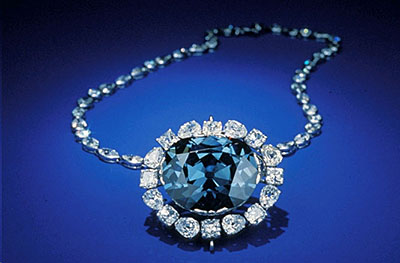 The history of the stone which was eventually named the Hope diamond began when the French merchant traveller, Jean Baptiste Tavernier, purchased a 112 3/16-carat diamond. This diamond, which was most likely from the Kollur mine in Golconda, India, was somewhat triangular in shape and crudely cut. Its color was described by Tavernier as a "beautiful violet."
Tavernier sold the diamond to King Louis XIV of France in 1668 with 14 other large diamonds and several smaller ones. In 1673 the stone was recut by Sieur Pitau, the court jeweler, resulting in a 67 1/8-carat stone. In the royal inventories, its color was described as an intense steely-blue and the stone became known as the "Blue Diamond of the Crown," or the "French Blue." It was set in gold and suspended on a neck ribbon which the king wore on ceremonial occasions.
King Louis XV, in 1749, had the stone reset by court jeweler Andre Jacquemin, in a piece of ceremonial jewelry for the Order of the Golden Fleece (Toison D'Or). In 1791, after an attempt by Louis XVI and Marie Antoinette to flee France, the jewels of the French Royal Treasury were turned over to the government. During a week-long looting of the crown jewels in September of 1792, the French Blue diamond was stolen.
In 1812 a deep blue diamond described by John Francillion as weighing 177 grains (4 grains = 1 carat) was documented as being in the possession of London diamond merchant, Daniel Eliason. Strong evidence indicates that the stone was the recut French Blue and the same stone known today as the HopeDiamond. Several references suggest that it was acquired by King George IV of England. At his death, in 1830, the king's debts were so enormous that the blue diamond was likely sold through private channels.
The first reference to the diamond's next owner is found in the 1839 entry of the gem collection catalog of the well-known Henry Philip Hope, the man from whom the diamond takes its name. Unfortunately, the catalog does not reveal where or from whom Hope acquired the diamond or how much he paid for it.
Following the death of Henry Philip Hope in 1839, and after much litigation, the diamond passed to his nephew Henry Thomas Hope and ultimately to the nephew's grandson Lord Francis Hope. In 1901 Lord Francis Hope obtained permission from the Court of Chancery and his sisters to sell the stone to help pay off his debts. It was sold to a London dealer who quickly sold it to Joseph Frankels and Sons of New York City, who retained the stone in New York until they, in turn, needed cash. The diamond was next sold to Selim Habib who put it up for auction in Paris in 1909. It did not sell at the auction but was sold soon after to C.H. Rosenau and then resold to Pierre Cartier that same year.
In 1910 the Hope diamond was shown to Mrs. Evalyn Walsh McLean, of Washington D.C., at Cartier's in Paris, but she did not like the setting. Cartier had the diamond reset and took it to the U.S. where he left it with Mrs. McLean for a weekend. This strategy was successful. The sale was made in 1911 with the diamond mounted as a headpiece on a three-tiered circlet of large white diamonds. Sometime later it became the pendant on a diamond necklace as we know it today. Mrs. McLean's flamboyant ownership of the stone lasted until her death in 1947.
Harry Winston Inc. of New York City purchased Mrs. McLean's entire jewelry collection, including the Hope diamond, from her estate in 1949. This collection also included the 94.8-carat Star of the East diamond, the 15-carat Star of the South diamond, a 9-carat green diamond, and a 31-carat diamond which is now called the McLean diamond.
For the next 10 years the Hope diamond was shown at many exhibits and charitable events world wide by Harry Winston Inc., including as the central attraction of their Court of Jewels exhibition. On November 10, 1958, they donated the Hope diamond to the Smithsonian Institution, and almost immediately the great blue stone became its premier attraction.
The Hope diamond has left the Smithsonian only four times since it was donated. In 1962 it was exhibited for a month at the Louvre in Paris, France, as part of an exhibit entitled Ten Centuries of French Jewelry. In 1965 the Hope diamond traveled to South Africa where it was exhibited at the Rand Easter Show in Johannesburg. In 1984 the diamond was lent to Harry Winston Inc., in New York, as part of the firm's 50th anniversary celebration. In 1996 the Hope diamond was again sent to Harry Winston Inc., in New York, this time for cleaning and some minor restoration work.
The weight of the Hope diamond for many years was reported to be 44.5 carats. In 1974 it was removed from its setting and found actually to weigh 45.52 carats. It is classified as a type IIb diamond, which are semiconductive and usually phosphoresce. The Hope diamond phosphoresces a strong red color, which will last for several seconds after exposure to short wave ultra-violet light. The diamond's blue coloration is attributed to trace amounts of boron in the stone.
In the pendant surrounding the Hope diamond are 16 white diamonds, both pear-shapes and cushion cuts. A bail is soldered to the pendant where Mrs. McLean would often attach other diamonds including the McLean diamond and the Star of the East. The necklace chain contains 45 white diamonds.
 | Mrs. Evalyn Walsh McLean wearing the Hope Diamond with the McLean Diamond (31.26 Carats) and Star of the East (94.8 Carats) attached |
In December of 1988, a team from the Gemological Institute of America visited the Smithsonian to grade the great blue stone using present day techniques. They observed that the gem shows evidence of wear, has a remarkably strong phosphorescence, and that its clarity is slightly affected by a whitish graining which is common to blue diamonds. They described the color as a fancy dark grayish-blue. An examination on the same day by another gemologist using a very sensitive colorimeter revealed that there is a very slight violet component to the deep blue color which is imperceptible to the naked eye. Still, one can only wonder that the original 112 3/16-carat stone bought by Tavernier was described as "un beau violet" (a beautiful violet).
The Hope Diamond
Hundreds of years old and coming from Golconda India it was originally 112 carats. A French merchant Jean-Baptiste Tavernier bought the stone around 1660.
Eight years later Louis XIV bought the gem from Tavernier and had his court jeweller cut it down to 67 carats. It was then given the name of French Blue and was set in gold as a necklace for the king to wear on ceremonial occasions.
It was at the French court that the gemstone acquired its reputation as being linked with evil forces. One of the king’s mistresses wore the gem and subsequently fell out of favour with the court. Louis XIV died of gangrene and as the French revolution came King Louis XVI and his wife lost their heads. The diamond was then stolen.
That was the end of the stone as it was then known. It is believed that it was recut into three stones. One of these stones came into the possession of a London jeweller named Eliason who sold it to a banker Lord Henry Philip Hope. It seems the darker forces came into play again and the Hope diamond was thought to be responsible for the Hope family becoming insolvent.
Famous jeweller Cartier made it into a piece of jewellery and sold it to Evalyn Walsh McLean who was also a victim of the curse of the Hope diamond as her son was hit by a car and killed. She suffered a tragic life after that.
Harry Winston finally acquired the stone and donated it to the Smithsonian Institute. Winston sent it in the mail in a plain brown paper bag. He did not believe in the curse and live to the ripe old age of 82.
It now weighs 45.52 carats and is described as a Fancy dark greyish blue. The clarity is VS1.
It is easy to see how the supposed curse gained credibility. It was told that Tavernier, the original owner of the large stone, had stolen it from a Hindu idol. A priest of the temple was said to have placed a curse on whoever possessed the gem from then on. So we had a string of what should be considered normal, but unfortunate, incidents happening to people owning or associated with the stone and the legend of evil continued.
Thursday, January 10, 2008
Saturday, January 5, 2008
Subscribe to:
Posts (Atom)